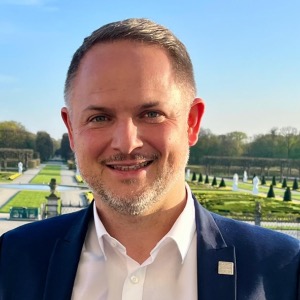

Christian is Professor of Political Science and International Organizations at Friedrich Schiller University Jena and co-director of the MA International Organizations and Crisis Management. He is also a Research Fellow at the Global Governance Center of the Geneva Graduate Institute. His main research interests are related to the governance of transboundary crises, regime complexity, and contestations of international order.
The Death of Diplomacy by Design: Is Europe Trapped in a Permanent Emergency?
Europe seems trapped between crisis management and long-term vision. From your work on emergency politics: is the EU drifting toward a model of “permanent exceptionalism,” and what does that mean for democratic legitimacy?
Indeed, I think there is a tendency in this direction. Exceptionalism or emergency politics, that is, the adoption of drastic measures breaking with established norms based on justifications of urgency and necessity, may not yet have become the constant mode of politics in the EU. Yet, it seems that deeper institutional or policy reform, be it through more or less integration, nowadays hardly comes about in modes other than emergency. The EU has reached a point of institutional gridlock where competing member state interests and public contestation disallow smooth, technocratic reform processes. Europe’s political leaders – national and supranational – resort to security and emergency rhetoric to muster support for what they deem necessary adjustments in face of internal as well as external “threats.”
The EU is increasingly shaped by informal practices and legal derogations accepted in the shadow of “crisis”, from the (self-)empowerment of the ECB and unilateral border closures to fend off migration to NextGenEU and its ad hoc RRF. Currently, the greatest push goes towards defense integration to attain greater geopolitical power, justified by the Russia’s invasion of Ukraine. Each of these measures can be debated for its political merit. From a democratic legitimacy perspective, however, such “permanent exceptionalism” is only likely to further undermine the already fragile legitimacy enjoyed by European institutions and – increasingly – national governments. Repeatedly overcoming political and public resistance through appeals to necessity is bound to increase that resistance long-term.
3. Germany’s shift from Wandel durch Handel to “de-risking” marks a profound intellectual reversal. Do you think Berlin has fully grasped the governance consequences of treating China as a systemic competitor rather than a reformable partner?
I think Germany is undergoing a period of even more fundamental uncertainty than “only” connected to China. The United States, for most of post-War German history a key ally, economic partner, and shepherd in global politics, has turned into an extremely powerful bully that seeks to undermine European unity and support the right-wing political fringes. If we talk “systemic competitors,” then we need to talk about both China and the US. With regard to neither of them, I think, has Berlin fully grasped the consequences yet. While most policy-makers certainly do no longer cater to any naïve dream of democratizing and ‘liberalizing’ China, there still remains a relatively clear strategic lacuna in how to approach an economically expanding great power who is using its state-led capitalism to sideline competition and stabilize autocracies. This is even more true with regard to the US where a strategic rethink is yet to happen. Germany – and the EU for that matter – have to realize that their foreign trade and foreign policy models are phasing out.
EU–Africa relations are being reframed as a partnership of equals — at least rhetorically. From a global governance perspective, what would it take for the EU to overcome entrenched asymmetries and build a genuinely co-authored agenda with African states?
This is a big question. Honestly, I don’t think the EU can (or even wants to) engage with “Africa” on equal footing as long as deeply engrained colonial imaginaries and racialized narratives continue to dominate in European capitals. Still, the idea is that a strong and wealthy continent needs to assist a weak and poor continent, without recognition of the historical and structural patterns of exploitation that produced and continue to reproduce these inequalities.
I am not sure that the Chinese way is the more desirable, either. China leverages the idea of “South-South” cooperation with Africa to signal a shared fate and historical commonality in colonialism. While clearly more successful than Europe and the US on the African continent, China’s approach is equally hypocritical as it is essentially also geared towards extraction.
5. John Mearsheimer’s appearance at the European Parliament in late November sparked strong reactions. What does the popularity of such pessimistic great-power narratives reveal about Europe’s strategic anxieties — and do they obscure more constructive ways of thinking about global order?
Mearsheimer is a populist among international relations scholars. He caters to fear and basic instinct and makes it all sound so simple. That’s dangerous, especially from a so-called expert.
There is no denying that the architecture of international order is transforming fast and that “great powers” or “spheres of influence” are back on the table. My colleague, Stacie Goddard, pointedly argued in a recent Foreign Affairs piece that Trump, Putin, and Xi are united by a vision akin to a globalized version of the 19th century Concert of Europe: mutual respect among the great powers, unfettered discretion in their respective “backyards.” This is a reality that the EU and other backyards have to reckon with.
The problem with Mearsheimer’s arguments is not only that they are overly simplistic, but also that he casts power politics among states as inevitable constants in human existence. That is, he lends justification and credence to offensive practices in international politics appealing to law-like axioms of a highly reductionist and flawed theory according to which states have but one option to survive: maximizing power.
Instead of showing how things could be different, and how a better global order could look like, this approach suggests: change is impossible. Yet, the fact that global order is transforming is in itself proof, that other worlds are indeed possible, that people have agency, choose certain paths over others, in ways that are not always linear. This possibility to influence the fate of global order is not necessarily productive, as Trump is showing day-by-day. But at least it shows that the abyss is not inevitable.
6. Looking across Berlin’s international scene, what is one blind spot you see in Europe’s current debate on global governance — the issue we are simply not taking seriously enough?
A major blind spot in Berlin’s current debate on global governance is how fundamentally the ground beneath multilateralism is shifting — and what is quietly replacing it. We often talk about a “crisis of multilateralism,” but we still tend to assume that weakened international organizations can somehow be repaired or stabilized. In reality, we are witnessing a more profound transformation: sustained funding cuts, political contestation, and strategic disengagement – from UN reform debates to U.S. exits and threats of exit – are hollowing out public multilateral authority faster than many acknowledge.
What is filling this gap is not a return to state-centric governance, but an accelerating move toward multistakeholder and hybrid arrangements that bring private actors into the core of global governance. This trend is frequently framed as pragmatic and inevitable. Yet the deeper problem is that if hybrid governance becomes the default – rather than a complement – we risk losing the capacity to define and protect the public good at the global level.
Hybrid constellations tend to privilege speed, scalability, and investment logics, but they systematically weaken accountability, regulatory ambition, and distributive justice. The blind spot, then, is not hybridity per se, but the absence of a serious debate about what happens when it becomes the only form of global governance left.