Global Economic Fragilities, EU Strategic Autonomy, Germany's Middle-Tech Trap, France's Structural Crisis, WeihnachtsZauber Gendarmenmarkt, Ringing in 2026
Which famous Christmas song was originally written for Thanksgiving?
Jingle Bells
Fun Fact: Written by James Lord Pierpont and published in 1857 under the title „The One Horse Open Sleigh,“ it was intended to be sung during the Thanksgiving season. It wasn’t until decades later that it became associated with Christmas.
 Dear Readers,
Welcome to the Diplomacy Berlin Newsletter.
As the festive lights of the Kurfürstendamm cut through the December grey, we arrive at our final edition of 2025. This time of year naturally invites reflection, and looking back at the past twelve months, it is clear that the world has shed many of its illusions.
The stories we have curated this week hold up a sober mirror to this new reality. From the OECD’s warning of „increasing fragilities“ and the structural anxieties facing France, to Peter Bofinger’s sharp diagnosis of Germany’s technological lag, the message is consistent: the economic autopilots of the past no longer function. This is reinforced by the European Parliament’s latest study on Strategic Autonomy and European Competitiveness, which serves as a stark manifesto for a continent realizing that security can no longer be outsourced and that resilience must now take precedence over efficiency.
As the ECFR’s 18th-anniversary discussion highlights, Europe is being forced to „come of age“ rapidly in a geopolitical landscape that has become transactional and often unforgiving. Yet, even as global currents grow turbulent, the importance of maintaining bridges – both literal and diplomatic – has never been greater. In our exclusive interview, David Russ, Technical Production Manager of the WeihnachtsZauber Gendarmenmarkt, reflects on how Berlin’s most iconic Christmas market is far more than a seasonal attraction. Set at the heart of the city, it becomes a space where tradition, culture, and quiet diplomacy meet, offering international visitors and Berliners alike a shared moment of encounter, exchange, and belonging.
In this spirit, we also turn to the things that sustain us through the Berlin winter. Whether it is the culinary diplomacy of Kanaan or simply the pragmatic act of staying healthy during the dark months, resilience is often built in small, daily acts of care and community.
Diplomacy Berlin will now take a winter pause to recharge. We will return to your inboxes on January 6th, ready to navigate a 2026 that promises to be just as complex and demanding.
Thank you for reading, for engaging, and for being part of this dialogue for the better part of 2025. I wish you restful holidays, a peaceful Christmas, and a confident start to the New Year.
If you would like to contribute articles, event coverage, or press releases for our return in January, please reach out at editorial@diplomacy.berlin.
Un abrazo,
Sigrid Arteaga
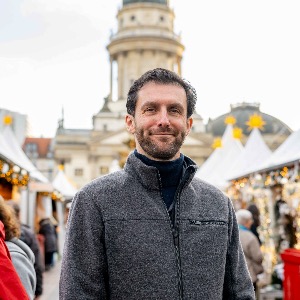
David Russ on the WeihnachtsZauber Gendarmenmarkt: Where Berlin's Christmas Tradition Meets the World
David Russ, 43, is a social economist and has been working as a technical project manager at WeihnachtsZauber Gendarmenmarkt GmbH for six years. In addition, he is responsible for public relations and communication with the gastronomy sector. He oversees the positioning of the WeihnachtsZauber Gendarmenmarkt brand and develops the strategic direction for the future of the Christmas market.
How did the WeihnachtsZauber Gendarmenmarkt come about, and what makes it special to this day?
The Christmas market at Gendarmenmarkt was conceived in 2003 at the Berlin Tourism Round Table and publicly tendered. The aim was to enliven the square, Berlin’s city center, and the state of Berlin during the darker months of the year, while also supporting the hospitality sector. Since then, the WeihnachtsZauber Gendarmenmarkt has combined traditional craftsmanship, high-quality gastronomy, and cultural programming on one of Europe’s most beautiful squares. With around 700,000 visitors each year, it is a place where Berlin’s urban community, regional guests, and an international audience come together in an atmosphere that blends tradition with contemporary staging.
What significance does the Gendarmenmarkt hold as an iconic location in the heart of Berlin, especially in an international context?
With its ensemble of the German Cathedral, the French Cathedral, and the Konzerthaus, the Gendarmenmarkt represents Berlin’s history and European urban culture like few other places. Its immediate proximity to ministries, embassies, cultural institutions, and international hotels makes it a natural meeting point for Berlin’s global community. For many international visitors, a visit to the WeihnachtsZauber Gendarmenmarkt offers an emotional entry point to the city—a moment in which Berlin becomes tangible and deeply felt.
What role does the Christmas market play for international visitors, expats, and Berlin’s urban community as a whole?
The WeihnachtsZauber Gendarmenmarkt is a shared space for Berliners, international guests, and expats alike. For the local community, it is part of a lived Christmas tradition; for many international visitors, it is a defining experience of their time in Berlin. Embassies, cultural institutes, and companies use the market as a place for informal encounters and quiet diplomacy. Our goal is to further develop the Christmas market as an open place of encounter and cultural exchange, thereby enriching the surrounding district in a lasting way.
How is the market’s cultural diversity reflected, particularly through collaboration with artisans and cultural practitioners?
This diversity is most visible in the craftsmanship and on the stage. We work with artisans from Berlin, from many regions across Germany, and from other European countries—ranging from traditional wood carving and millinery to contemporary jewelry and textile art. Many artisans produce their work on site, allowing visitors to observe the creative process. Music, dance, and artistic performances on the stage turn the market into a small cultural festival during Advent.
International guests are an integral part of the market. What role do they play, and how do they shape the WeihnachtsZauber Gendarmenmarkt?
International visitors bring their own traditions, expectations, and perspectives, making the market a place of lived cultural diversity. One hears many languages, encounters different ways of celebrating, and senses how strongly the WeihnachtsZauber Gendarmenmarkt shapes Berlin’s image around the world. This influences our work—from multilingual communication to offerings that are distinctly German while remaining open to international tastes. In this way, the market combines strong local roots with international appeal and becomes a visible symbol of diversity, mutual understanding, and peaceful coexistence.
What particular challenges and opportunities come with organizing such a renowned Christmas market?
One of the greatest challenges is balancing high quality standards with security requirements, heritage protection, noise control, and sustainability—within a sensitive historic urban space and under intense public scrutiny. At the same time, this presents a major opportunity: the WeihnachtsZauber Gendarmenmarkt can demonstrate that a large, internationally recognized Christmas market can be organized responsibly, with a coherent security concept, carefully selected stalls, fair working conditions, and a conscious use of resources. Another ongoing task is preserving tradition while introducing new elements each year, so that the market remains engaging for both returning visitors and first-time guests.
From your perspective, what sets the WeihnachtsZauber Gendarmenmarkt apart from other Christmas markets in Berlin and beyond?
In my view, five elements stand out: the unique setting of the Gendarmenmarkt, the strong focus on authentic craftsmanship, the sophisticated gastronomy concept, the daily stage program, and the deliberately curated overall design of the market. Many Christmas markets are either very traditional or primarily experience-driven; the WeihnachtsZauber Gendarmenmarkt aims to combine both. It is a place where visitors can browse, enjoy, and marvel at a relaxed pace, while still offering a clear and distinctive identity. The fact that it regularly attracts guests from around the world makes it a small festive showcase for international Berlin.
Strategic Autonomy and European Competitiveness (December 2025)
The recent study requested by the ECON committee, „Strategic Autonomy and European Competitiveness,“ argues for a fundamental paradigm shift: economic performance must now become secondary to establishing resilience against geopolitical coercion. With the EU’s security environment deteriorating, the authors posit that strategic autonomy – specifically reducing reliance on the US for defense and China for critical raw materials – is the absolute prerequisite for regaining policy freedom. The study underscores a stark reality for Berlin and Brussels: NATO commitments are projected to rise to 3.5% of GDP, and European defense production must arguably increase fivefold to gain a decisive advantage over Russia. Critically, this marks a sobering admission that the „peace dividend“ era is definitively over, forcing the EU to prioritize „good enough“ resilient outcomes over purely efficient economic ones, a trade-off that will inevitably strain national budgets.
Operationally, the report offers a sharp critique of the bloc’s sluggish reform pace, noting that only 11% of the Draghi report’s recommendations have been adopted a year post-publication. It advocates for a pragmatic, tiered industrial policy that prioritizes centralized funding for „European public goods“ – such as energy grids and defense infrastructure – to overcome the inefficiency of market fragmentation. Furthermore, in a significant departure from traditional EU doctrine, the study urges a pivot away from stalled multilateralism toward aggressive bilateral trade deals to secure supply chains. However, this approach exposes a dangerous governance gap: the call for centralized EU funding and „sovereign“ projects clashes with the persistent lack of political will among Member States to cede fiscal control, potentially leaving these necessary strategic ambitions unfunded and unexecuted.
To read the full study, visit the European Parliament website.
OECD Economic Outlook, Volume 2025 Issue 2: Resilient Growth but with Increasing Fragilities
The OECD’s latest Outlook presents a global economy that has defied recessionary predictions but is entering a precarious new phase defined by „increasing fragilities.“ The report outlines a fundamental shift where geopolitical security is actively displacing economic efficiency, evidenced by the sharp deceleration in global trade volumes projected for 2026. For the diplomatic community, the most critical signal is the „unprecedented increase“ in US effective tariffs to 14%, which the OECD warns will not only dampen output but fundamentally rewire global supply chains. The analysis suggests that while a „soft landing“ has been achieved, it has come at the cost of higher debt burdens and fragmented markets. This new reality forces a move away from the „peace dividend“ economics of the past decades, necessitating a strategy where resilience against external shocks – whether trade wars or supply crunches – takes precedence over pure cost optimization.
For Berlin, the report serves as both a warning and a strategic roadmap. While Germany’s growth remains sluggish at 0.3% for 2025, the Outlook highlights a pivotal shift in domestic policy: a projected rebound to 1.0% in 2026 is largely predicated on a „strong rise“ in public spending on defence and infrastructure, enabled by increased flexibility in national fiscal rules. This marks a significant departure from Berlin’s traditional fiscal orthodoxy, driven by the necessity to modernize the Bundeswehr and decarbonize the industrial base. For diplomats and policymakers, this implies a dual challenge: Germany must navigate an increasingly protectionist global landscape that threatens its export-led model, while simultaneously managing a domestic transition towards a more demand-driven economy powered by state investment. The Outlook underscores that securing new energy partnerships and diversifying trade lanes is no longer just economic policy, but a critical security imperative for the Bundesregierung.
To read the full study, visit the OECD official website.
ECFR at 18: Has European Foreign Policy Come of Age?
Marking the European Council on Foreign Relations’ 18th anniversary, this podcast contrasts the „peak optimism“ of 2007 – when democracy seemed ascendant—with today’s „age of disorder.“ Panelists Carl Bildt, Lykke Friis, and Norbert Röttgen dissect a Europe forced to mature rapidly. Röttgen outlines a fundamental paradigm shift in Berlin, citing imminent conscription legislation and a defense budget projected to rise to €150 billion – figures unimaginable at ECFR’s founding. However, the discussion reveals a darker „Second Zeitenwende“: a sense of betrayal by the United States. The panel details a shocking diplomatic maneuver where Washington reportedly intervened with Belgium to block Europe’s financing of Ukraine via frozen Russian assets, demanding a US-managed fund with guaranteed revenues. This underscores a brutal reality where Europe is navigating not just Russian aggression, but a transactional and potentially hostile transatlantic partner.
Critically, the conversation exposes the limits of Germany’s new assertiveness. While Röttgen identifies a Germany-Poland axis as the new center of continental defense, he warns that Berlin „cannot go it alone“ despite a domestic consensus on rearmament. The panelists candidly admit to a collective failure in predicting the full scale of Russian revisionism, acknowledging that Europe’s „ambivalent optimism“ often clouded strategic foresight. Looking toward 2043, the discussion suggests that the EU must abandon the ideal of uniform integration in favor of a „concentric Europe,“ a necessary pragmatic shift to preserve democratic values in a fragmented global order.
To listen to the full episode, visit the ECFR website.
How is France Becoming a Third World Economy?
CaspianReport’s analysis exposes the disintegration of France’s post-war social contract, revealing a harrowing disconnect between the nation’s self-conception as a wealthy welfare state and the „abstract reality“ of its financial insolvency. The video outlines a vicious feedback loop where a shrinking demographic base and stagnant productivity can no longer support a cradle-to-grave social model that has run deficits for 51 consecutive years. This structural rot has created a bifurcated reality: a hyper-wealthy, luxury-exporting Paris detached from a de-industrialised, decaying periphery, mirroring the dynamics of developing economies. The core crisis identified is not merely economic but political and psychological; a fragmented parliament renders necessary reform impossible, while the bond markets are beginning to lose the „belief“ that French debt is fundamentally safe. The analysis suggests that without a radical technological intervention—such as the mass adoption of robotics to offset labour shortages—or a painful renegotiation of its social promises, France faces a slow-motion slide into strategic irrelevance and sovereign debt crisis.
Watch the full video on Caspian Report’s YouTube Channel.
- First China ore shipment rewards Guinea coup leader’s push for Simandou alliance. scmp.com
- Putin’s Already Won – He’s exposed fatal divisions in the “West” even as Russians still back his Ukraine invasion. foreignpolicy.com
- America Has a New Ally in Syria and Wants Israel to Get on Board. wsj.com
- West Africa is in an emergency, ECOWAS says. africanews.com
- French PM scores big win as social security budget clears major hurdle. politico.eu
- New report warns of mounting planetary crises — and pathways to hope. news.mongabay.com
Germany's Middle-Technology Trap: Industrial Policy Blindness and the Path Out
Peter Bofinger delivers a scathing diagnosis of the German economy, identifying a „middle-technology trap“ where the nation is squeezed between Chinese state planning and American digital dominance. He argues that Berlin’s adherence to the „garage narrative“ – the belief that markets alone drive innovation – ignores the historical reality that US tech supremacy was forged through massive state-led defense spending. This ideological blindness has left Germany’s top firms (averaging 129 years old) vulnerable to disruption, evidenced by the automotive sector shedding 50,000 jobs in a single year and GDP remaining stagnant for six years.
Critically, Bofinger highlights a wasted opportunity in the recent debt brake reform: while €30 billion is being poured into energy subsidies to prop up legacy industries, only €4.5 billion is allocated to high-tech development. He suggests a pragmatic, if cynical, path forward: Germany must exploit the debt brake’s unlimited exemption for defense spending (above 1% of GDP) to implement a „hidden“ industrial policy. By channeling defense funds into dual-use technologies, Berlin could mimic the US Cold War model to finally catalyze the digital innovation it desperately lacks.
To read the full article, visit Social Europe.
2025: A World Under Pressure - And Germany's Moment of Strategic Choice
As 2025 comes to an end, the world finds itself neither stabilised nor fully unravelling, but suspended in a state of accumulated tension. From the India–Pakistan confrontation and renewed conflict in Southeast Asia, to U.S. military action in Venezuela, diplomatic ruptures in Latin America, the unresolved wars in Ukraine and Gaza, and a global tightening of borders, this year revealed how fragile the mechanisms of restraint have become. Power proved fragmented, responsibility often deferred, and red lines increasingly blurred.
For Germany, these developments carry particular weight. As a country whose prosperity and influence depend on multilateral order, predictable diplomacy, and economic openness, Berlin has been forced to confront a harsher reality: stability can no longer be assumed, and strategic ambiguity is no longer cost-free. Europe’s growing focus on defence readiness, migration control, and economic security reflects this shift, as does Germany’s own struggle to balance restraint with leadership.
Read more on Diplomacy.Berlin’s website.
The Berlin University Alliance (BUA) forges a strategic nexus between Freie Universität, Humboldt-Universität, TU Berlin, and Charité, transforming the German capital into an integrated global research hub. Leveraging the federal Excellence Strategy, BUA tackles transnational „Grand Challenges“—from global health architectures to social cohesion—by dismantling institutional silos and fostering transdisciplinary innovation. Its mandate extends beyond academia, driving knowledge exchange that informs urban policy and scientific diplomacy, ensuring Berlin remains a pivotal node in the global knowledge economy while addressing the complex crises defining the 21st century.
Visit their website to track the Berlin University Alliance’s latest research and initiatives.
YEAH 26! New Year’s Eve at the Brandenburg Gate
Ring in 2026 at Berlin’s most iconic landmark with a spectacular open-air celebration. From 10 pm to 1 am, the area around the Brandenburg Gate transforms into a vibrant party zone featuring DJ sets spanning pop, 80s/90s classics, and Afrobeats. The night culminates at midnight with a massive fireworks display illuminating the capital’s skyline, followed by electro beats to kick off the new year. Admission is strictly limited to ticket holders, with free tickets released starting December 15th. To secure your spot for the capital’s top party, visit the visitBerlin website.
Long Night of the Sciences
Berlin’s Innovation After Dark On June 6th–7th, Berlin’s most prestigious research hubs unlock their doors for the Lange Nacht der Wissenschaften, transforming the capital into a nocturnal laboratory of discovery. From 5 pm to midnight, over 60 institutions across Berlin and Potsdam offer rare public access to restricted archives, high-tech labs, and lecture halls usually reserved for academics. With more than 1,000 events spanning medicine, engineering, art, and sociology, this interactive showcase invites visitors to engage directly with scientists through live experiments, debates, and behind-the-scenes tours. It’s a unique opportunity to explore the city’s intellectual engine room and confront critical questions about the role of science in society. To buy tickets, visit the visitBerlin website.
Kanaan is perhaps Berlin’s most delicious experiment in culinary diplomacy. Founded by an Israeli and a Palestinian, this vibrant eatery in Prenzlauer Berg serves as a testament to the power of shared heritage over political division. Kanaan offers more than just exceptional vegan and vegetarian Middle Eastern cuisine; it offers a vision of coexistence served on a plate.
The menu is a restorative journey through family recipes, featuring some of the city’s best hummus, fresh salads, and homemade baked goods. With its warm, unpretentious atmosphere, it is an ideal spot for those seeking both comfort food and a touch of optimism. For the diplomatic community, Kanaan provides a tangible reminder of how culture can bridge divides, delivering a dining experience rooted in peace, friendship, and genuine hospitality.
Orthomol Immun is your essential survival tool when the Berlin winter turns grey, wet, and relentlessly cold. This science-backed, pocket-sized defence supports your immune system with 25 vital micronutrients, including Vitamin C, D, and Zinc. The menthol-raspberry granules melt instantly without water, making them perfect for busy days on the go. Gluten-free and lactose-free, this comprehensive formula is the ultimate ally for staying healthy and energised through the capital’s longest, darkest months.