
The U.S.-Venezuela Limited War of 2025: A Legal and Strategic Assessment
Friday, 12. December 2025
Hamid Ali M.
The relationship between the United States and Venezuela has deteriorated sharply since late 2024, culminating in what many analysts now describe as a de facto, limited war in 2025. While there has been no formal declaration of war or large-scale ground invasion, the U.S. has conducted sustained military strikes at sea, deployed a major naval task force to the southern Caribbean, and adopted a posture of coercive diplomacy that blurs the line between counter-narcotics operations and regime-change warfare. This article outlines the key military, diplomatic, and legal developments in the Venezuela-U.S. conflict as of mid-December 2025, with a focus on the legality of U.S. actions under international and domestic law.
Military Escalation and the “War of 2025”
Since late August 2025, the United States has carried out a series of military strikes against small vessels in the Caribbean that it alleges are used by Venezuelan drug traffickers and armed groups. These operations, often referred to as “Operation Southern Spear,” have killed at least 80-83 people in more than 20 separate attacks on boats, including controversial “double tap” strikes that targeted survivors in the water. The U.S. justifies these actions as part of a counter-narcotics campaign, but the scale and lethality of the strikes, combined with the political context, have led many observers to characterize them as the opening phase of a limited war against the Maduro government.
In parallel, the U.S. has deployed a powerful naval task force to the southern Caribbean, centered on the supercarrier USS Gerald R. Ford and its accompanying strike group, which includes guided-missile destroyers, a cruiser, a nuclear-powered submarine, and F-35 stealth fighters. This buildup is officially framed as a counter-narcotics and maritime security operation, but it functions as a coercive signal to Caracas, demonstrating the ability to project force close to Venezuela’s shores. The Pentagon has also designated Venezuela’s “Cartel de los Soles” and the Tren de Aragua gang as Foreign Terrorist Organizations (FTOs), a move that expands the legal and operational options for targeting individuals and assets linked to the regime.
On 10 December 2025, U.S. special forces launched from the USS Gerald R. Ford and seized a major crude oil tanker off the Venezuelan coast, accusing its owners of smuggling sanctioned Venezuelan and Iranian oil. This seizure is widely interpreted as part of a broader strategy to strangle Venezuela’s oil exports and increase economic pressure on the Maduro government. U.S. officials have indicated that further maritime interdictions and potential land-based strikes are being prepared, though no large-scale ground invasion has yet been launched.
Diplomatic and Political Breakdown
The current crisis is rooted in the disputed July 2024 presidential election in Venezuela, which Nicolás Maduro claimed to have won with 51.2% of the vote. The opposition and international observers, including the United States and the European Union, rejected the results as fraudulent, and the new U.S. administration has since declared the Maduro regime illegitimate and terminated all back-channel diplomatic contacts. Direct communication channels are now officially closed, with no functioning embassies in either capital.
The U.S. has adopted a “maximum pressure 2.0” strategy, combining harsh sanctions with military signaling. In early 2025, the U.S. revoked Chevron’s operating license, severing the last major energy link between the two countries. A punitive tariff was imposed on any nation purchasing Venezuelan crude, and Venezuelan nationals in the U.S. were stripped of certain legal protections. The administration has also sharply increased the reward for Maduro’s capture to $50 million, explicitly linking him to drug trafficking and “narco-terrorism,” a move widely seen as a shift from sanctions to active leadership decapitation.
In response, Maduro has mobilized Venezuela’s Bolivarian Militia, claiming to have activated over 4 million members, and staged large-scale “resistance” drills and military exercises. He has declared a “republic in arms” posture and warned of a prolonged guerrilla war if the U.S. invades, with plans for small units to conduct sabotage from over 280 locations. This dynamic has created a classic security dilemma: each side’s defensive measures are perceived as offensive by the other, raising the risk of miscalculation and unintended escalation.
Legal Analysis: Jus ad Bellum
Under international law, the use of force by one state against another is governed by the United Nations Charter, which prohibits the threat or use of force except in cases of self-defense or with Security Council authorization (Article 2(4)). The United States justifies its strikes against vessels in the Caribbean and Pacific as acts of self-defense under Article 51, arguing that these operations are directed against “narco-terrorist” threats emanating from Venezuela.
However, this justification faces serious legal challenges. For self-defense to be lawful, there must be an “armed attack” or an imminent threat of such an attack, and the response must be necessary and proportionate. The available evidence suggests that the vessels targeted were small drug boats, not a conventional military force capable of launching an armed attack on U.S. territory. Independent UN experts and human rights bodies have therefore concluded that the U.S. strikes violate the prohibition on the use of force and amount to unlawful extrajudicial killings, not legitimate self-defense.
Moreover, the U.S. practice of killing suspects at sea without arrest or trial transforms what should be a law-enforcement operation into a military one, raising the threshold for the use of force. Under international human rights law, lethal force is only permissible as a last resort when individuals pose an imminent threat to life, a standard that the “double tap” strikes and similar operations appear to violate. The UN High Commissioner for Human Rights has explicitly stated that these strikes breach international human rights law and constitute extrajudicial executions.
Legal Analysis: Jus in Bello and Human Rights Law
If the situation is treated as an armed conflict, the United States must comply with international humanitarian law (IHL), including the principles of distinction, proportionality, and precautions in attack. The “double tap” strikes on survivors in the water raise serious concerns about compliance with IHL, as they may constitute attacks on persons who are hors de combat (out of combat) and could amount to war crimes.
Even if the situation is not classified as an armed conflict, the operations must still conform to international human rights law, which applies at all times. The right to life, the prohibition of arbitrary deprivation of life, and the requirement of due process are fundamental norms that bind the United States regardless of the legal characterization of the conflict. The U.S. practice of conducting lethal strikes against individuals without trial, and without clear evidence that they posed an imminent threat, is widely criticized as a violation of these norms.
Human rights groups and UN experts emphasize that counter-narcotics operations are law-enforcement matters, not armed conflict, and must be conducted under strict human rights standards, not the more permissive rules of IHL. The current U.S. approach, which relies on military force rather than judicial process, undermines the rule of law and sets a dangerous precedent for the use of force in similar contexts.
U.S. Constitutional and Domestic Law Issues
Under the U.S. Constitution, the power to declare war rests with Congress (Article I), while the President serves as Commander in Chief (Article II). The War Powers Resolution of 1973 requires the President to report hostilities to Congress within 48 hours and to terminate them within 60–90 days unless Congress authorizes further action. The current Venezuela campaign raises serious constitutional questions, as there has been no declaration of war, no specific authorization for the use of force against Venezuela, and no plausible claim of an imminent armed attack on the United States that would justify unilateral executive action.
Legal scholars argue that the sustained military strikes and naval buildup exceed the President’s constitutional authority and that Congress has failed in its duty to authorize or limit the conflict. While Congress has twice rejected resolutions that would limit the President’s authority to continue military action against Venezuela, it has not passed a new Authorization for Use of Military Force (AUMF) for Venezuela, leaving the operations on constitutionally shaky ground. The refusal of the administration to release video of the 2 September strike, which critics have labeled a potential war crime, further undermines transparency and accountability.
UN and Regional Diplomacy
Venezuela has formally appealed to the UN Security Council, accusing the United States of fabricating a war pretext and violating international law, and has requested an emergency session to halt U.S. military aggression. The appeal is supported by China and Russia, which hold veto power, and the Council has held closed-door consultations on the crisis. The UN Secretary-General and senior officials have repeatedly urged restraint, warning that the U.S. strikes heighten regional tensions and risk destabilizing the Caribbean.
The UN High Commissioner for Human Rights has called for an immediate cessation of the strikes and for prompt, independent investigations into the reported killings. Regional organizations, including the Organization of American States, have expressed concern about the erosion of the norm against the use of force and the potential for a wider conflict in the hemisphere. The situation has also drawn criticism from traditional U.S. allies, who worry that the campaign sets a precedent that could be used against them in the future.
Current Status and Outlook
As of mid-December 2025, the situation remains at a high level of tension but has not yet escalated to a full-scale war. The United States maintains its naval and air presence in the Caribbean and continues maritime interdictions, while the Maduro government is on high alert, conducting military exercises and preparing for a potential guerrilla resistance. President Trump has stated that “ground strikes in Venezuela will begin shortly,” but has not specified timing, targets, or whether U.S. troops will be deployed on the ground, leaving the exact next phase uncertain.
Congress remains divided, with some Republicans expressing concern about the legality and wisdom of further escalation, while Democrats largely oppose any invasion or regime-change war. The opposition in Venezuela, led by figures such as María Corina Machado, has welcomed increased U.S. pressure as a means to force Maduro from power, but there is growing recognition that removing Maduro does not guarantee a better outcome and could lead to further chaos and bloodshed.
In sum, the Venezuela–U.S. conflict as of December 2025 represents a dangerous case of coercive diplomacy that has crossed the threshold into limited armed conflict. The U.S. military operations, while framed as counter-narcotics actions, appear to violate both international law and the U.S. Constitution, and the risk of unintended escalation remains high. A sustainable resolution will require a return to diplomacy, respect for international legal norms, and a clear congressional mandate for any further use of force.
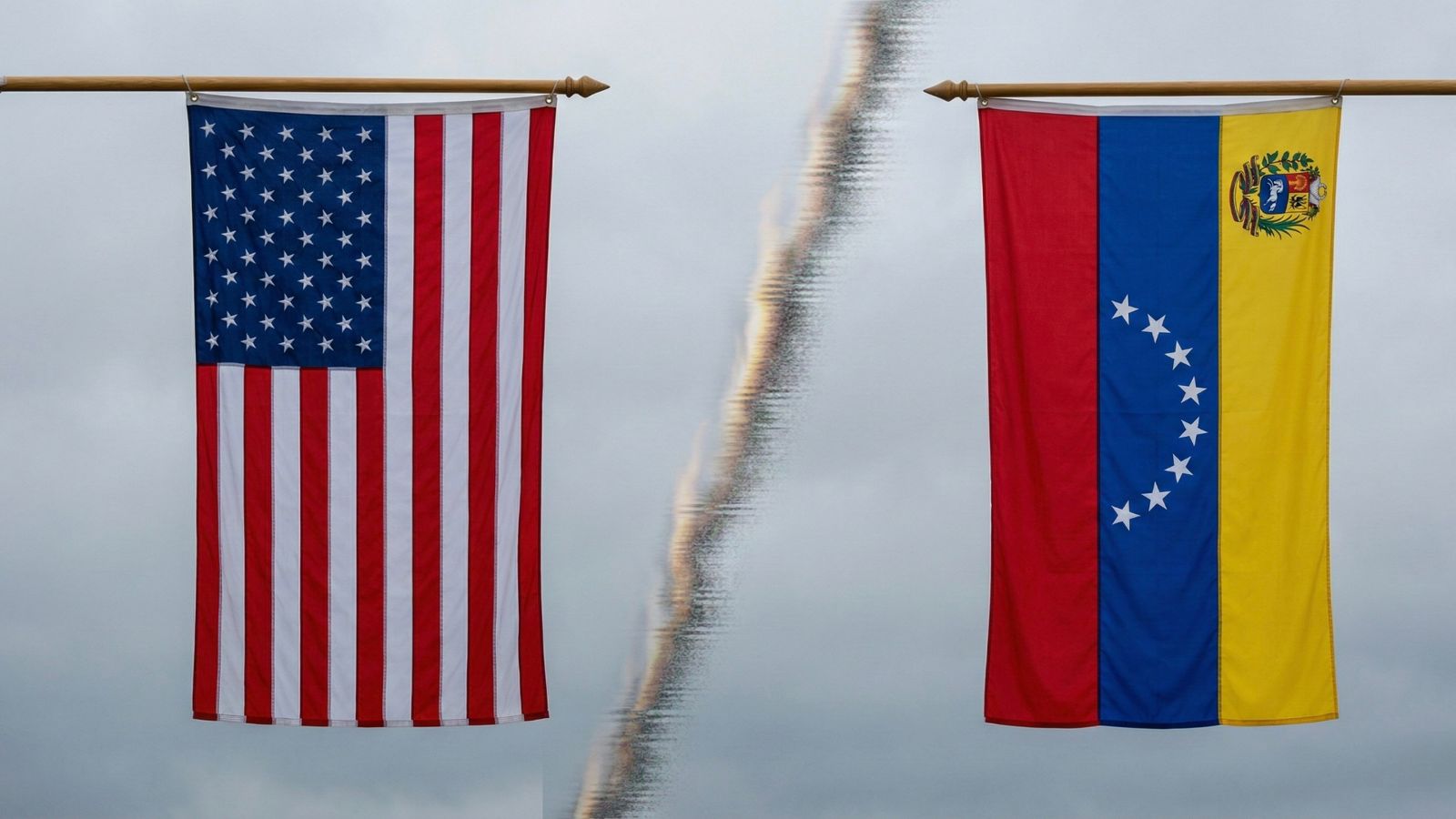
Illustration generated using AI (Gemini), for illustrative purposes only.

The World in Focus: Highlights from Foreign Affairs’ Best Books of 2025
19. Dezember 2025


2025: A World Without Resolution
15. Dezember 2025
The U.S.-Venezuela Limited War of 2025: A Legal and Strategic Assessment
12. Dezember 2025