
Latin America's role in Europe's future, EU-US Energy Agreement, European Energy Grids, Germany and Kenya's Migration Agreement, Stress Test of Euro Area Banks
Which South American country currently holds the rotating presidency of MERCOSUR in the second half of 2025?
Paraguay
 Dear Readers,
Welcome to this week’s Diplomacy Berlin Newsletter.
This week, we spotlight Latin America’s growing importance for Europe, featuring insights from Diana Luna of the Friedrich Naumann Foundation. Major trends include the Mercosur-EU trade push, renewable energy advances, China’s influence, and the impact of skilled migration. Diana also highlights Venezuela’s vibrant grassroots movements, underscoring why Europe must pay closer attention.
In this edition, we explore KPMG’s latest report showing a cooling in Latin America’s growth, the EU-US $750 billion energy deal stressing efficiency over LNG imports, and a podcast on Europe’s resilient interconnected power grids. A recent video examines Donald Trump’s impact on halting Nord Stream, reshaping Europe’s energy landscape. Meanwhile, the ECB and EBA’s 2025 bank stress test reinforces financial confidence.
We would also like to take a moment to congratulate Afghanistan (19th August) and Ukraine (24th August) on their Independence Day.
If you would like to submit a text for our upcoming newsletters or press releases, please send it to editorial@diplomacy.berlin.
With best regards,
Sigrid Arteaga
Bridging Continents: Diana Luna on why Latin America Matters for Europe's Future
Diana Luna is the Latin America Policy Advisor at the Friedrich Naumann Foundation in Potsdam/Berlin, where she leads strategic coordination across Mexico, Central America, the Andean region, and Mercosur. With prior roles managing projects in the Middle East, North Africa, and Latin America, she brings extensive international expertise. She is also a recognized commentator in German and international media on democracy and governance in Latin America.

From your vantage point as Latin America Policy Advisor at FNP, what emerging political or economic trends in the region do you believe European policymakers are currently underestimating?
Europe is overlooking several dynamic shifts reshaping Latin America:
- Trade as a catalyst: Unlocking a full Mercosur-EU trade agreement could transform the region’s economy, deepen democratic governance, and foster multilateral growth. Geopolitical tensions are making Latin America an increasingly attractive partner for trade diversification, while modernizing EU agreements with Mexico and Chile expands opportunities for innovation, sustainable trade, and stronger Europe-Latin America connections.
- Energetic transition: Latin America is racing toward a renewable revolution while controlling the critical resources that will power it. Costa Rica and Uruguay already generate up to 98% of their electricity from clean energy, even though infrastructure gaps remain. Argentina, Brazil, Chile, and Bolivia hold lithium, rare earths, and other strategic minerals. This makes the region both a supplier and a global power broker in the energy transition. Europe has a timely opportunity to partner and accelerate this shift.
- China’s growing footprint: Chinese investments in infrastructure are reshaping Latin America’s political and economic landscape. Rising dependencies could limit regional autonomy, making Europe’s strategic engagement more urgent than ever.
- Attractive high-skilled migration: Latin America offers a growing pool of highly skilled professionals in healthcare, technology, and other key sectors. Programs such as the EU-Mexico nursing agreement not only address labor gaps but also strengthen cultural and professional ties, creating mutually beneficial transatlantic networks.
In your work bridging Latin America and Germany, what strategies have you found most effective in fostering mutual understanding and productive dialogue between such different political and cultural contexts?
Soft power is Latin America and Carribean’s secret weapon. Music, food, and cultural exchange break the ice before policy talks even begin. By focusing on shared interests above the crises of the moment—such as green hydrogen initiatives in Chile, educational exchanges in Mexico, or digital innovation in Brazil—participants discover common ground that strengthens bilateral relations. Highlighting similarities rather than differences shortens the distance across the Atlantic.
If you could spotlight one overlooked Latin American initiative, leader, or grassroots movement that deserves greater attention in European policy circles, what would it be and why?
Grassroots movements like Vente Venezuela show the power of civic engagement against all odds. María Corina Machado’s fight for democracy and a prosperous Venezuela deserves Europe’s urgent attention. In the first half of 2025 alone, 48,000 Venezuelans applied for asylum in the EU—more than from Afghanistan or Syria. The humanitarian and political ripple effects are already felt here and could escalate if the crisis continues unabated.
Latin America slows in the second half of 2025 - Europe keeps watch
After a brisk start, Latin America’s growth momentum faltered in the third quarter of 2025, as noted in KPMG’s latest outlook. Lower consumer demand, persistent inflation, and more restrictive financial conditions have been exacerbated by softer exports to China and commodity price swings. The slowdown reverberates well beyond the region. Sectors ranging from automotive to agriculture are watching regional trends closely, balancing exposure in Latin America against shifting economic prospects at home, as analysts predict this cooling may temper European growth ambitions linked to Latin America for the remainder of the year. You can know more about it on KPMG’s website.
Efficiency First, Not LNG: Rethinking the EU-US Energy Agreement
The EU’s newly announced $750 billion energy import deal with the United States for 2026–2028 has sparked debate over its alignment with Europe’s Green Deal and long-term energy transition goals. In „Efficiency First, Not LNG: Rethinking the EU–US Energy Agreement,“ Diplomacy Berlin spotlights the analysis of Vlasis Oikonomou and Wolfgang Eichhammer from the Institute for European Energy and Climate Policy (IEECP). The experts emphasize that prioritizing energy efficiency over increased LNG imports is critical for advancing decarbonization, enhancing energy security, and supporting Europe’s strategic autonomy. Their perspective urges policymakers to shift focus toward demand reduction, electrification, and investment in sustainable infrastructure. Read the full article on Diplomacy Berlin.
Podcast Spotlight: Resilience and Innovation in Europe's Power Grids
The „Energy to Ear“ podcast, featuring researchers Kristina Nienhaus and Felix Nitsch from the German Aerospace Center’s Institute of Networked Energy Systems, offers a compelling discussion on the resilience and cost-effectiveness of interconnected European energy grids. Released in August 2025, the episode titled „Europe’s power grids – connected, volatile, indispensable“ dives into how past extreme weather events inform the future design of energy systems in Germany and Central Europe through the VERMEER research project. It highlights the challenges posed by climate change on renewable energy production, emphasizing the need for flexibility and interconnected power market zones to balance natural fluctuations and ensure a reliable power supply. Listen to the full episode on DLR Institute of Networked Energy Systems website.
Trump Boasts "I Ended Nord Stream" Pipeline, Deepening EU Dependence on US Energy
In a recent video, former President Donald Trump claimed credit for halting the Nord Stream pipeline, which transported Russian gas directly to Germany. The move, framed by Trump as a strategic victory, has significantly altered Europe’s energy landscape by increasing EU’s reliance on U.S. oil and gas supplies. This move has sparked intense debate about the long-term consequences for European autonomy and energy costs. Critics argue that by effectively severing a key direct energy link, Europe’s dependence on transatlantic imports has grown, which raises questions about the resilience and diversification of the EU’s energy strategy. To understand what exactly is the Nord Stream, watch the full video on Geopolitical Economy Report Youtube’s channel.
- Not Unprecedented but Unprincipled. Whatever Trump does, his Alaska summit is already a win for Putin and a loss for Europe. foreignpolicy.com
- Former chairman of the Nato-Military-Committee Rob Bauer: „The Chinese President is the only person who can stop the war.“ diplo.news
- Kleber Group opens office in Cape Town. pr-journal.de
- Africa energy group opposes talks on global plastics cut. semafor.com
Frequently asked questions about the 2025 stress test for euro area banks
The European Central Bank (ECB) and the European Banking Authority (EBA) have released a detailed FAQ on the 2025 stress test for euro area banks. It is designed to assess the resilience of 96 major banks under severe economic scenarios. The test simulates adverse events like rising tariffs, disrupted supply chains, and inflation shocks to evaluate how banks can withstand economic pressures and maintain capital adequacy. This exercise is critical for identifying vulnerabilities in the banking sector and guiding future supervisory measures to safeguard financial stability in the eurozone. It also reflects ongoing efforts to integrate emerging risks, including climate-related financial threats, into the oversight framework. For more details, visit the official ECB’s webiste.
Pamoja or Power Play? The Germany & and Kenya's Migration Agreement
Germany and Kenya’s migration agreement, signed in September 2024, sets up new legal pathways for skilled Kenyan workers, trainers, and students to move to Germany, while Kenya agrees to facilitate the repatriation of Kenyan nationals, including those with expired documents. Lauded as a win-win initiative, the pact reflects Germany’s pressing need to address its labor shortages amid demographic changes, and Kenya’s efforts to create opportunities for its youthful population, much of which faces unemployment. The deal exemplifies a blend of humanitarian rhetoric and realpolitik, offering coordinated, regulated migration and return procedures. Read more on Diplomacy Berlin’s website.
Centre for European Policy Studies (CEPS): A Leading Brussels-Based Think Tank on EU Policy: CEPS is a prominent independent think tank located in Brussels, focusing on comprehensive analysis and practical solutions for European Union policy challenges. Founded in 1983, CEPS is renowned for its rigorous research and policy expertise across a broad spectrum of topics including economic governance, financial regulation, climate and energy, digital transformation, and foreign affairs. The organization engages closely with EU institutions, governments, and industry stakeholders to facilitate informed debate and evidence-based policymaking. For more information, visit their official website.
European Rule of Law Conference 2025 – A Forum for Democracy and Justice
Join the European Rule of Law Conference from September 15-16, 2025, in Berlin, hosted by re-constitution, for a vital two-day event focusing on the state and future of democracy. The conference gathers scholars, policymakers, civil society members, and journalists for a collaborative exchange on pressing issues like upholding EU values amid political polarization, combating anti-democratic trends, and ensuring human rights protections. The event registration is free, making it a unique opportunity to engage with key stakeholders. For more details and registration, visit the official conference page.
Berlin's Young Euro Classic
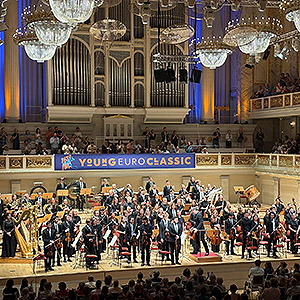
Once again, Berlin’s Young Euro Classic brought together the world’s most promising young orchestras for an unforgettable night on the Gendarmenmarkt. Visitors settled in with a refreshing Aperol Spritz, immersed in a summer tradition that has flourished for more than 26 years. The evening was a vibrant showcase of talent from Europe and beyond with each ensemble infusing classical music with youthful energy and diverse perspectives. Against the stunning backdrop of Berlin’s historic square, the festival captured the excitement and promise of new artistic journeys, offering audiences a perfect blend of culture, camaraderie, and summer night magic.
This week, we dine at ROCA, Waldorf Astoria Berlin’s modern Mediterranean restaurant in the city center. ROCA features fresh, sustainable dishes like the original Eggs Benedict, Waldorf Salad, and Red Velvet Cake. Guests enjoy a stylish interior and a seasonal terrace with views of Berlin’s Memorial Church. Ideal for breakfast, lunch, or dinner, ROCA offers a creative and elegant dining experience. Explore menus and more details on their official website to plan your visit.
Discover Berlin with Whitlams Berlin Tours: Explore Berlin’s rich history and vibrant culture with Whitlams Berlin Tours this August. Choose from a variety of themed walking tours, including Berlin Highlights, the iconic Ku’damm, Friedrichstrasse In-Depth, the Nazi Government Quarter, and the Berlin Wall. Popular tours like Karl-Marx-Allee and Weimar-era Berlin have already sold out, so book soon to secure your spot. Tours are scheduled on weekends of August 23, 24, 30, and 31, with limited availability. Sign up now via the link in their bio, and remember to cancel if your plans change to free up space for others.